
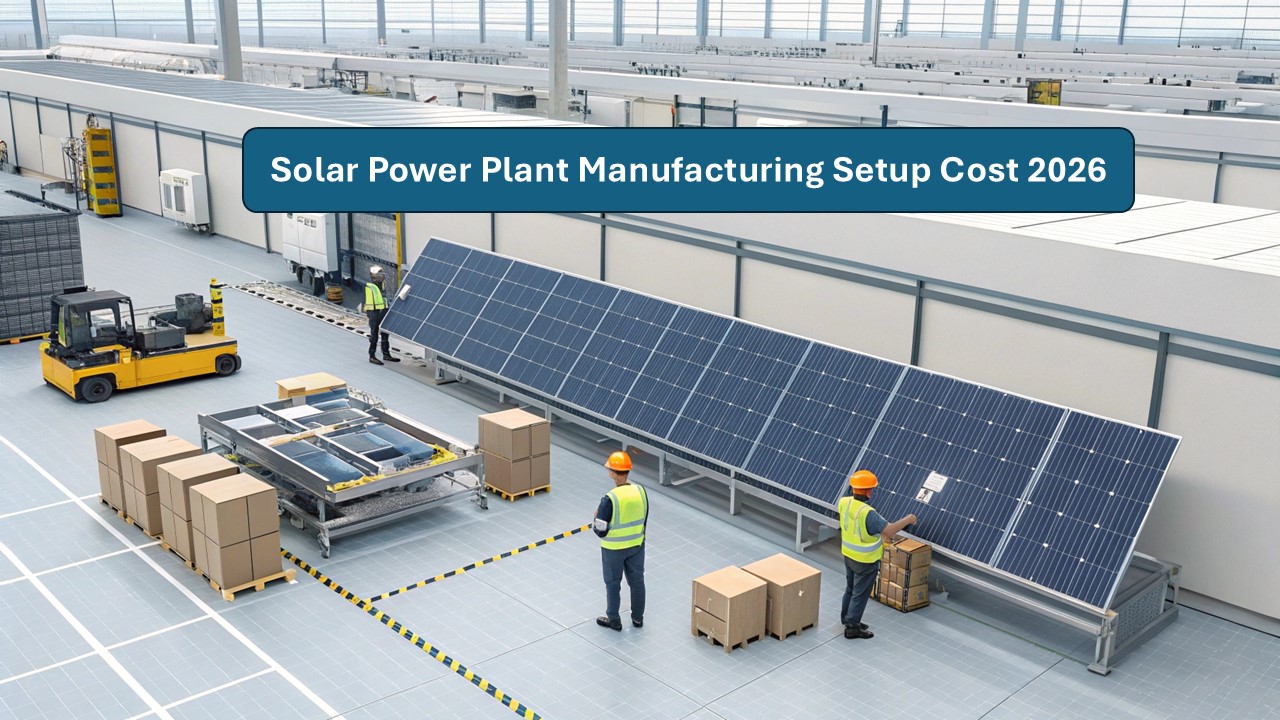
The Solar Power Plant Manufacturing Plant Project Report 2026 presents an in-depth feasibility analysis for establishing a solar power manufacturing facility that produces photovoltaic modules and related solar power equipment. Solar power harnesses the sun’s radiation and converts it into electricity through photovoltaic (PV) systems, making it a clean, renewable, and environmentally sustainable energy source that helps reduce reliance on fossil fuels and mitigate climate change. The solar manufacturing industry plays a critical role in supporting global renewable energy targets — particularly as nations accelerate energy transition strategies and decarbonization policies.
The IMARC report outlines the complete business model for a solar power manufacturing plant — including market trends, raw material requirements, machinery and technology needs, unit operations, cost structures, financial projections, and investment viability. It provides essential insights for investors, developers, and entrepreneurs aiming to participate in this rapidly expanding sector.
Market Overview and Growth Potential
The global solar power market is witnessing remarkable growth, driven by rising demand for clean and sustainable energy solutions. According to IMARC’s estimates, the global solar power market was valued at USD 170.23 Billion in 2025 and is expected to reach USD 468.28 Billion by 2034, exhibiting a strong CAGR of 11.9% from 2026 to 2034.
This upward trajectory is propelled by increasing adoption of solar energy across residential, commercial, industrial, and utility-scale applications. Government incentives, supportive renewable energy policies, declining photovoltaic technology costs, and growing investments in renewable infrastructure have collectively contributed to the expansion of the solar manufacturing industry. Solar power is viewed as a cornerstone of global decarbonization initiatives, particularly as countries adopt net-zero commitments and sustainable energy targets.
Plant Capacity and Production Scale
The proposed solar power manufacturing facility is designed with an annual production capacity of approximately 500 MW of solar modules. This production scale enables the plant to achieve significant economies of scale while maintaining operational flexibility to adapt to shifting market demand and technological advancements.
Production processes covered in the IMARC report include solar cell assembly, module assembly, quality testing, and packaging — all essential for producing high-performance solar power modules that meet industry standards.
Request for a Sample Report: https://www.imarcgroup.com/solar-power-plant-manufacturing-plant-project-report/requestsample
Financial Viability and Profitability Analysis
Financial feasibility is a crucial part of assessing any manufacturing project. For a solar power manufacturing plant, the profitability analysis presented in the IMARC report highlights the following:
• Gross Profit Margin: 10–20%• Net Profit Margin: 4–10%
These profit ranges reflect the competitive nature of the solar manufacturing industry, stability of demand, and value-added nature of solar power components. The financial model also includes projections for income and expenditure, capital recovery, ROI (Return on Investment), NPV (Net Present Value), and break-even analysis — providing investors with a comprehensive economic outlook.
Operating Cost Structure
Operating costs in a solar power plant manufacturing setup are largely driven by raw material consumption, particularly solar cells and module components. According to IMARC:
• Raw Materials: 85–90% of total operating expenses (OpEx)• Utilities: 5–8% of OpEx
Raw materials — including solar cells, EVA encapsulant sheets, tempered glass, backsheet, and aluminium frames — form the most significant portion of operating expenditure. Securing reliable suppliers and negotiating long-term contracts can help stabilize costs and ensure consistent production quality. Utilities, including electricity, water, and power for manufacturing operations, contribute a smaller but still important share of ongoing expenses.
Additional operating expenses, such as labor, maintenance, packaging, transportation, and environmental compliance, are accounted for in the full IMARC cost model to provide a detailed understanding of overall OpEx.
Capital Investment Requirements
The IMARC feasibility study outlines key capital investment components required to establish a solar power manufacturing facility. While specific investment figures are provided only in the detailed paid report, major CapEx categories include:
• Land acquisition and site development — selection should consider access to key raw materials, transportation networks, utilities, and waste management systems.
• Civil works and infrastructure — construction of production halls, quality control labs, storage facilities, and administrative units.
• Machinery and equipment — essential machinery includes ingot casters, wire saws, screen printers, tabber-stringers, laminators, module framers, testing stations, simulation machines, and packaging systems.
• Utilities and support systems — electrical, water, steam, and environmental monitoring installations.
CapEx also covers safety, environmental compliance systems, and initial working capital needed to initiate production. The exact cost breakdown is available in the full project report, which can guide detailed financial planning and decision-making.
Major Applications and Market Segments
Solar power modules manufactured at the plant serve multiple critical applications including:
• Photovoltaic systems for utility-scale solar farms• Residential solar installations• Commercial and industrial rooftop systems• Off-grid and rural electrification projects• Solar-integrated hybrid energy systems
Solar modules are also used in related infrastructure such as mounting frameworks, inverters and power electronics, and energy storage systems — expanding the market reach beyond basic electricity generation.
These segments highlight the versatility of solar power manufacturing and its importance in supporting energy needs across residential, commercial, and utility-level applications.
Ask Analyst for Customization: https://www.imarcgroup.com/request?type=report&id=7835&flag=C
Why Invest in Solar Power Manufacturing?
Investing in a solar power manufacturing plant aligns with global energy transition priorities and offers several strategic advantages:
Clean & Sustainable Energy Driver
Solar power is a vital component of renewable energy strategies worldwide, facilitating reductions in carbon emissions and fossil fuel dependency.
Rapid Market Growth
The projected increase from USD 170.23 Billion (2025) to USD 468.28 Billion by 2034, with a CAGR of 11.9%, indicates strong market demand and investment opportunities.
Government Policies & Incentives
Supportive renewable energy policies, incentives, and mandates accelerate deployment and manufacturing of solar power technologies, enhancing sector attractiveness.
Diverse Applications
Solar modules have broad utility across residential, commercial, industrial, and utility-scale energy projects — creating multiple demand streams.
Technology Advancements
Continued improvements in photovoltaic efficiency, production automation, and integration with energy storage and grid systems help reduce levelized cost of energy (LCOE) and improve return on investment.
These combined factors make solar power manufacturing an attractive and future-oriented investment in the renewable energy landscape.
Conclusion
The Solar Power Plant Manufacturing Plant Project Report 2026 offers a comprehensive investment guide for establishing a solar module manufacturing facility. With a projected annual capacity of around 500 MW, healthy profit margins (gross 10–20%, net 4–10%), and a clear cost structure driven primarily by raw materials, solar power manufacturing presents a promising opportunity for investors aligned with renewable energy growth. Supported by favorable market conditions, policy incentives, and expanding clean energy demand, this sector offers sustainable long-term prospects for technology, infrastructure, and energy transition investments.